
Science Fail
What one district’s recent science fail tells us about bad pedagogy


I. The answer six years in waiting
In May of 2026, the principal of La Cañada Unified School District’s (LCUSD) only middle school asked me a question that, depending on how you count, took six years or fifteen hundred to answer.
He wanted to know how parents would react if the district replaced its current 6-8 science curriculum, STEMscopes, with an alternative. The teachers using the curriculum were so dissatisfied that they were demanding replacement, even though a middle school adoption is normally meant to last a decade and STEMscopes had only been in place for five years. Replacement would cost the district real money — money paid twice for materials that should have lasted twice as long. The principal wanted to know whether parents would object.
The answer was easy, and some of us had been waiting six years to provide it.
II. What happened in 2019-20
In the fall of 2019, LCUSD’s middle school science teachers identified four finalist curricula for their grade 7 & 8 science adoption: Accelerate Learning’s STEMscopes, Delta Education’s FOSS Next Generation Middle School, Houghton Mifflin Harcourt’s California HMH Science Dimensions, and TCI’s Bring Science Alive! As is customary in LCUSD adoption cycles, parents were invited to review sample materials and submit feedback.
Nine of us did. Most were practicing scientists or engineers — parents employed at JPL, Caltech, or in adjacent technical roles. We ranked the four curricula on common criteria using a four-three-two-one points scheme. The aggregate ranking was unambiguous:
TCI – 36 points (selected first by all nine respondents)
(tie) HMH – 15 points
(tie) Delta FOSS – 15 points
STEMscopes – 13 points
I wrote my own review at the time, focused on the 7th and 8th grade STEMscopes sample materials for the district’s middle school. My summary was that STEMscopes was unacceptable. It had no textbook — only a consumable student workbook and an alphabetically-organized reference book — and that what factual content it contained about scientific principles and phenomena was “very thin and poorly written.” The reason for the no-textbook design was not subtle: STEMscopes’ own curriculum overview describes the program as “rooted in Bybee’s 5E model, Gardner’s theory of Multiple Intelligences” and built on “a commitment to helping teachers understand constructivist learning and inquiry-based teaching.”1 Constructivist curricula typically eschew textbooks for the same reason they eschew direct instruction — they hold that the student should construct knowledge through self discovery and guided inquiry rather than receive it from an authoritative source. Textbooks are anathema to inquiry learning proponents — a student who reads ahead might spoil the joy of discovery for fellow classmates.
The selection committee was the district’s middle school science teachers. They preferred STEMscopes. The parents — many of whom held Ph.D degrees in scientific disciplines and worked at one of the world’s premier space research institutions literally down the street from LCUSD’s high school — preferred TCI.
We made our concerns public. LCUSD’s Governing Board, to their credit at the time, delayed the planned adoption timeline by a month and asked “select JPL scientists” to catalog the scientific errors we alleged were present in STEMscopes and another curriculum piloted for grades K through 6. Several of us did this work in earnest. I personally cataloged errors in the 2nd grade STEMscopes Student Notebook over two weeks in January and February 2020 — a 14-page document with specific page references documenting factual errors (wrong species in an invasive species lesson, false claims about increasing natural disasters, internal contradictions about the states of water, paragraphs duplicated and original paragraphs omitted leaving questions unanswerable), conceptual errors (anthropomorphism of plants, teleological framing of matter), and content omissions (carbon dioxide absent from the list of what plants need, chemical and biological weathering absent from the definition of weathering).2
The Board then hired two so-called independent experts to review our cataloged concerns and render a judgment. The reviewers were professors in the California State University Northridge Department of Education — not the College of Science, the College of Engineering, or the College of Mathematics. Not chemists. Not biologists. Not physicists. Education school professors.3
The CSUN reviewers characterized our documented errors as “minor and inconsequential.” The Board adopted STEMscopes on the recommendation of the teacher selection committee and the post-hoc CSUN judgment.
Five years later, the teachers using the curriculum are demanding STEMscopes be replaced. According to second-hand reports, they have found the curriculum riddled with scientific errors that the publisher refuses to correct, and they have found teaching to the standards difficult without a textbook that can serve as a primary source. These are, almost verbatim, the concerns JPL parents raised in 2019 and 2020.
III. The vindication is not the point
There is a small temptation to make this story about being right. It would be satisfying to dwell on the fact that the CSUN review functioned exactly as it was designed to function, that the institutional response privileged teacher preference over documented parent expertise, and that the cost of the resulting decision is now being paid by students who experienced five years of substandard science instruction and by a district that must now pay twice for one curriculum cycle.
But the more important question is why a curriculum like STEMscopes fails so predictably, and why the failure is particularly severe in science class. The failure is not a quirk of STEMscopes per se. It is the predictable consequence of applying constructivist pedagogy to a subject where constructivist pedagogy fails harder than anywhere else.
That, in turn, has implications for how parents and educators should evaluate any science curriculum that comes their way, including the next one LCUSD will adopt.
IV. The cognitive science of novice learning
To understand why constructivist science fails, it helps to start with the general case.
The cognitive science of how novices learn is, at this point, reasonably settled. Two findings are central. First, according to Cognitive Load Theory, working memory is sharply limited — most adults can hold roughly four to six distinct items in the foreground of attention before performance degrades.4 Second, long-term memory is essentially unlimited and instantly recallable, but facts only get into long-term memory through deliberate encoding that builds organized structures called schemas. Once a schema exists in long-term memory, it can be activated rapidly and treated as a single chunk by working memory; this is the cognitive basis of expertise.
The implication for instruction is direct: novice learners, who lack foundational knowledge and derived schemas, cannot do what experts do. Asking a novice learner to engage in open-ended inquiry — to solve novel problems, to design experiments, to construct understanding from observation — places demands on working memory that exceed its capacity. The novice cannot reason about content she does not yet have organized in long-term memory, no matter how well-designed the inquiry activity is.
LCUSD administrators and educators, mirroring educators across the United States more broadly, give the constant refrain of developing “higher-order critical thinking skills” in their students over the inferior “rote memorization of facts.” Yet as cognitive psychologist Daniel Willingham has wryly noted, you need facts to think about.5
This is the central thesis of one of the most cited papers in modern educational psychology: Kirschner, Sweller, and Clark’s “Why Minimal Guidance During Instruction Does Not Work: An Analysis of the Failure of Constructivist, Discovery, Problem-Based, Experiential, and Inquiry-Based Teaching,” published in Educational Psychologist in 2006. The paper’s title is direct, and its argument is direct: pedagogies that ask novices to learn by doing what experts do — discovery learning, problem-based learning, inquiry-based learning, constructivist pedagogy generally — are theoretically incoherent and empirically unsupported when applied to material the learner does not already know.
A complementary framework comes from Norris Haring and Owen Eaton’s Instructional Hierarchy, originally developed for behavior analysis but generalized widely since.6
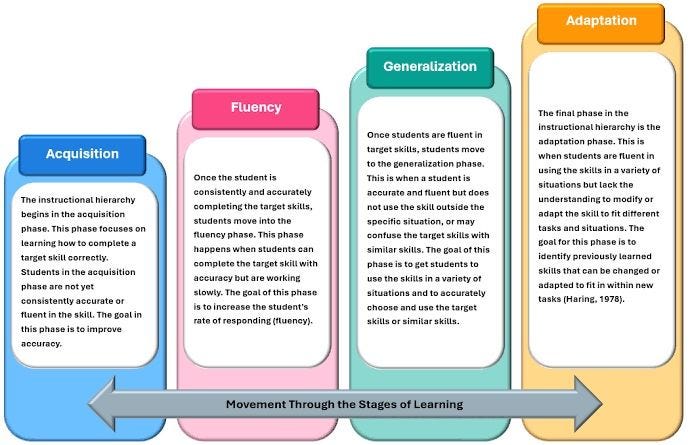
The hierarchy proposes four stages of learning any new skill: Acquisition (initial learning of accurate performance), Fluency (developing speed and automaticity), Generalization (applying the skill across contexts), and Adaptation (modifying the skill to novel problems). The pedagogies appropriate to each stage are different. Acquisition demands explicit instruction with high error correction; fluency demands deliberate practice; generalization and adaptation are where inquiry and problem-solving pedagogies appropriately come into their own.
The 5E model that STEMscopes and other constructivist science curricula are built on — Engage, Explore, Explain, Elaborate, Evaluate — explicitly places Explore before Explain.7 The student investigates the phenomenon first, and only afterward is the formal scientific account introduced. From a cognitive-load standpoint, this is the wrong sequence. The novice has no schema to organize his observations. He constructs whatever explanation his existing intuitions allow, and that explanation is often wrong. The Explain phase then has to dislodge a misconception the curriculum itself just installed.
This is the general case against constructivism. It applies wherever constructivism is applied to novice learners. It applies to math, where it has produced the multi-decade failures of Everyday Mathematics and similar reform-math curricula. It applies to literacy, where it produced Lucy Calkins’ Units of Study, Irene Fountas & Gay Su Pinnell’s Benchmark Assessment System and the broader “balanced literacy” movement that the Science of Reading is now quickly displacing.8
But it applies to science with particular force. And the reason it applies to science with particular force is the subject of the rest of this essay.
V. The subject where naive inquiry produces the wrong answer
Most school subjects involve content where careful, unaided observation by an intelligent person produces roughly the right answers. History involves events that happened; the student’s task is to learn them, not to derive them. Reading involves a language the student already uses. Even mathematics, for all its abstraction, builds on counting and measurement intuitions that mostly track reality.
Science is different. Science is the school subject where the curricular content very frequently contradicts the conclusions a careful unaided inquirer would reach.
A few examples:
Heavy objects do not fall faster than light objects in vacuum, but they appear to do so in air, and the appearance held human thought captive from Aristotle to Galileo — roughly nineteen hundred years.
The Earth orbits the Sun, but the Sun very obviously moves across the sky, and the Earth very obviously does not move under our feet. Ptolemy’s geocentric astronomy was the consensus of careful inquiry for thousands of years.
Combustion does not release a substance called phlogiston into the surrounding air, but phlogiston theory accounted for an impressive range of chemical observations and was the consensus chemistry of the 17th and 18th centuries, until Lavoisier’s experiments on oxidation in the 1770s revealed that combustion is a reaction with oxygen rather than the release of anything.
Maggots do not arise spontaneously from rotting meat, nor mice from grain and dirty rags, but the doctrine of spontaneous generation traced to Aristotle and was defended by serious natural philosophers into the 19th century, when Pasteur’s swan-neck flask experiments closed the question by demonstrating that sterile broth, protected from airborne organisms, did not generate life.
Disease is not caused by bad air rising from swamps and corpses, but the miasma theory of disease was the dominant medical paradigm in Western Europe for centuries, and it took the institutional development of germ theory and a great deal of microscopy to dislodge it.
Mental faculties and character traits cannot be read from the shape and bumps of the human skull, but phrenology was a serious scientific discipline through much of the 19th century — taught at universities, cited in hiring and criminal justice, and embraced by a generation of American intellectuals that included Walt Whitman, Henry Ward Beecher, and Horace Mann.
That last name deserves special attention. Horace Mann was the first Secretary of the Massachusetts Board of Education, the architect of the American common school system, and is routinely called the father of American public education. He was also a committed phrenologist. He used phrenological reasoning to argue for the educational reforms that built the modern American school system. He was a careful, conscientious, intellectually rigorous reformer — and the science he relied on was, in retrospect, wrong. The institutional commitments of one’s era are not, by themselves, evidence that those commitments are correct.In each of these cases, the wrong answer was the answer produced by careful, intelligent inquiry, conducted by people who were not stupid and who applied the methods of their era with rigor. Aristotle was not foolish. Ptolemy was not foolish. The physicians who held miasma theory were doing the best epidemiology available to them.
These people got the wrong answer because inquiry, unaided by accumulated knowledge, does not converge on the truth in science. It converges on intuitively appealing accounts that fit observation as far as observation goes. It does not, on its own, generate the conceptual revolutions that science actually requires.
The conceptual revolutions came from somewhere else. They came from the accumulation of mathematical techniques that could discriminate among hypotheses observation alone could not. They came from scientific instruments — the telescope, the microscope, the calorimeter, the spectroscope — that extended the senses past their native limits. They came from institutional structures that allowed knowledge to accumulate across generations: universities, scientific societies, journals, peer review. And they came, at certain critical moments, from individual genius operating in conditions of intellectual fragility that the institutions of the time often actively threatened. Bruno was burned. Galileo was forced to recant under threat of torture and spent the last nine years of his life under house arrest. Even when the institutional record is less violent, it is rarely supportive: continental drift was rejected by the geological establishment for half a century after Wegener proposed it, because the establishment held — correctly, in some sense — that no plausible mechanism existed.
The breakthrough mechanism in science has never been inquiry by untrained inquirers. It has always been the accumulation of theoretical framework, mathematical apparatus, instrumentation, and decades of careful experiments and observations using the scientific method that allowed inquiry to discriminate among hypotheses it previously could not.
A 7th grader has none of these things. A 7th grader does not have the mathematical apparatus to detect that heavy objects fall at the same rate as light ones in vacuum. A 7th grader does not have access to a vacuum chamber, nor the schema to know why she would need one. A 7th grader doing 5E-model “exploration” of falling objects will, predictably, observe that heavy objects fall faster — because they do, in air, and because she lacks the framework to know the air is the variable that matters. The curriculum then attempts to “Explain” Newton’s laws after the inquiry phase has already installed an Aristotelian intuition.
This is not a hypothetical. This is what happens.
VI. The working scientists’ witness: Cromer and Wolpert
The observation I have just laid out — that science is unnatural, that careful inquiry does not converge on it, and that the implications for education are direct — is not original to me. It was made explicitly and forcefully by two scientists writing for general audiences in the early 1990s, both of whom were also engaged in science education reform.
The first is Lewis Wolpert, a developmental biologist at University College London. His 1992 book The Unnatural Nature of Science makes the argument in its title.9 Wolpert holds that scientific ideas “are entirely counterintuitive and against common sense — by which I mean that scientific ideas cannot be acquired by simple inspection of phenomena and that they are very often outside everyday experience.” Wolpert grounds the argument in developmental psychology: children’s natural thinking is animistic (things have intentions), teleological (things happen for purposes), and egocentric (the observer is the reference frame). Science is unnatural precisely because it demands the systematic suppression of these tendencies. The implication for education is that science instruction has to work against what children spontaneously do, not with it.
The second is Alan Cromer, a physicist at Northeastern University, whose 1993 book Uncommon Sense: The Heretical Nature of Science makes the same argument with a sharper historical edge. Cromer holds that science is “not the natural unfolding of human potential, but the invention of a particular culture, Greece, in a particular historical period.” His thesis is that scientific thinking goes so far against the grain of ordinary human cognition that if it had not been invented in ancient Greece, it might not have been invented at all. He notes that science has died out before — in the medieval Islamic world, in late-Roman Europe — and could die out again. He explicitly argues that the “uncommon sense” required for science is fragile, that it is easily overwhelmed by what he calls the “infantile appeal” of magical and intuitive explanations, and that science education exists precisely to install and protect this fragile habit of mind.
Cromer was actively involved in middle school science curriculum reform when he wrote the book. His educational implications are direct: science cannot be effectively taught by methods that require students to recapitulate, unaided, what humanity required two thousand years of institutional effort to accomplish.
Both books are accessible to a general audience. Both were written by working scientists, not philosophers of education. Neither argues from the cognitive load tradition I cited earlier, yet they reach the same conclusion through history and philosophy of science instead. The convergence of independent arguments from different intellectual traditions is, in itself, a reason to take the conclusion seriously.
VII. The empirical record: Physics Education Research
The strongest empirical evidence for the position I am defending comes not from cognitive psychology or from philosophy of science, but from forty years of work in Physics Education Research (PER) — the discipline whose central finding is that students retain pre-Newtonian intuitions about mechanics through years of formal physics instruction, even into college.
The foundational instrument of this discipline is the Force Concept Inventory (FCI), developed by David Hestenes and colleagues at Arizona State University and published in The Physics Teacher in 1992.10 The FCI is a multiple-choice diagnostic that probes student understanding of basic Newtonian mechanics. It poses questions about force, motion, gravity, and the relationship among them. The questions are designed so that each wrong answer corresponds to a specific pre-Newtonian intuition (most often Aristotelian impetus theory, the belief that an object in motion must have a force on it).
The findings have been replicated across institutions for decades. Students arriving at university hold robust pre-Newtonian intuitions. After a semester of traditional lecture-based introductory physics, the average student’s FCI score improves by roughly 20% of the available improvement — a gain so modest that it implies most students are leaving introductory physics with their pre-Newtonian intuitions still substantially intact. This is true at Harvard. This is true at MIT. This is true wherever it has been measured. The most famous documentation of this finding is by Eric Mazur of Harvard, whose discovery that his own students could pass his exams while still believing essentially Aristotelian physics led him to invent what he calls peer instruction, a structured approach that explicitly targets misconceptions and that produces FCI gains of 60% or more.
The implications for K-12 science education are devastating to the constructivist project. If Aristotelian intuitions about mechanics survive multiple semesters of formal college physics taken by some of the most academically prepared students in the country, the proposition that 7th graders will discover Newtonian mechanics through student-centered learning and guided inquiry is empirically untenable. They will not discover it. They will install Aristotelian intuitions that future instruction will have to spend significant effort to dislodge — if it ever succeeds. And the dislodging, when it happens, will happen through explicit instruction in the correct conceptual framework, supported by interventions specifically designed to confront the misconception. It will not happen through more 5E-model “exploration.”
This literature, taken together with the cognitive-load theory argument and the history-of-science argument, makes the position essentially overdetermined. Three independent lines of argument converge on the same conclusion: constructivist inquiry pedagogy is the wrong way to teach science to novice learners.
VIII. The philosophical critique of constructivism in science education
A fourth line of argument, complementary to the three above, comes from the philosophy of science education itself. The leading figure here is Michael R. Matthews of the University of New South Wales, whose 1994 book Science Teaching: The Role of History and Philosophy of Science and his 1998 edited volume Constructivism in Science Education: A Philosophical Examination together constitute the most sustained philosophical critique of constructivism in science education yet published.
Matthews’s central point is that constructivism conflates two distinct claims. The first is a reasonable cognitive claim that learners integrate new content with prior knowledge — that the learner is not a blank slate, that prior conceptions shape new learning, that effective instruction has to account for what the learner already believes. This claim is empirically well-supported and not in dispute. The second is an epistemological claim that knowledge is what the learner constructs — that there is no external standard of correctness, that scientific knowledge has no foundation outside the learner’s construction of it. This claim is corrosive to the very subject being taught. Working scientists do not believe knowledge is what the learner constructs. They believe knowledge is what survives confrontation with evidence under the discipline’s accumulated theoretical and methodological constraints. Constructivist science education, in its strong forms, attempts to teach science through an epistemology that science itself rejects.
The result is the doctrinal incoherence we see in curricula like STEMscopes: a program that claims to teach science while denying the epistemological foundations of science, that asks students to “construct” understanding of phenomena while the actual scientific account of those phenomena required centuries of disciplined institutional work to develop, and that presents itself as honoring scientific inquiry while implementing a model of inquiry no working scientist would recognize.
IX. NGSS and the implementation tradition
A point of precision, because it matters for advocacy. The Next Generation Science Standards (NGSS), adopted by California in 2013 and in force in our schools today, are sometimes described as mandating constructivist pedagogy. This is not strictly true, and the imprecision is worth correcting.
NGSS prescribes Performance Expectations that integrate three dimensions: Disciplinary Core Ideas, Science and Engineering Practices, and Crosscutting Concepts. These are content and practice standards. They specify what students should know and be able to do at each grade level. They do not, formally, mandate any particular pedagogy for getting them there.
The constructivist tilt that has come to dominate NGSS-aligned curricula comes from elsewhere — primarily from the National Research Council’s 2012 Framework for K-12 Science Education, which shaped how NGSS was developed and which leans heavily toward constructivist and inquiry-based pedagogy in its supporting materials. It comes also from the curriculum publishers themselves, who are mostly in the constructivist tradition and who interpret the Performance Expectations through that pedagogical lens. It comes from the appendices to NGSS and from the implementation guidance that has followed, most notably the 2016 California Science Curriculum Framework.
In principle, a curriculum could teach NGSS content and practices through explicit instruction with strong content sequencing, paced and structured by cognitive load theory, with inquiry reserved for the generalization and adaptation phases of the instructional hierarchy. The fact that no such curriculum exists in the major commercial market is a fact about the publishing industry and the ed-school networks that train its authors and reviewers, not a fact about the standards.
This distinction matters because the strongest version of the argument aims at the implementation tradition, not at the standards themselves. NGSS is not the issue. Constructivist pedagogy, masquerading as the only way to implement NGSS, is.
X. What this means for parents and educators
If the argument I have laid out is correct, several practical things follow for how parents and educators should evaluate K-8 science curricula.
First, the absence of a substantive textbook is a serious red flag.
A working science classroom needs a primary source of organized content that the student can return to, study from, and use to consolidate understanding outside the lesson. The argument that curricula don’t need textbooks because students “construct understanding” through inquiry is precisely the argument cognitive science rejects. Look at the student-facing materials. If what the student takes home is a workbook with empty boxes and prompts to discover, the curriculum is structurally constructivist regardless of what it says on the cover.
Second, examine the 5E sequencing.
If the curriculum places Explore before Explain — the inquiry phase before the formal instruction phase — for content the student does not already know, the curriculum is asking the student to construct understanding without the framework knowledge required to construct it correctly. This is the most common single design choice that produces the predictable misconception problem.
Third, ask what happens with counter-intuitive content specifically.
When the curriculum addresses material that conflicts with naive observation — heliocentrism, Newtonian mechanics, atomic theory, evolution, plate tectonics — does it install the correct framework first and use inquiry to deepen understanding, or does it ask students to “discover” content their unaided observation predictably gets wrong? The latter is the case for most NGSS-aligned constructivist curricula. The former is what the cognitive science literature, the history-of-science literature, and the Physics Education Research literature all support.
Fourth, examine the assessments.
Constructivist curricula often substitute “performance tasks” and “claim-evidence-reasoning” exercises for content-knowledge testing. These have their place in the generalization and adaptation phases of learning, but they are not appropriate substitutes for assessments that probe whether the student has acquired the underlying content. A curriculum that cannot tell you whether students have learned the core content is a curriculum that cannot tell you whether it is working.
Fifth, take seriously the testimony of parents with subject-matter expertise.
This is not a class-based or credential-based argument. It is a recognition that parents who hold graduate degrees in scientific disciplines and who use scientific methods in their daily work are bringing genuine expertise to bear when they review a science curriculum. Their concerns deserve weight at least equal to that of the teacher selection committee, particularly when the committee is selecting from among curricula the publishers have already framed in constructivist terms. At a minimum, their inputs should not be constrained and whitewashed so as not to disquiet teachers on instructional material selection committees.
XI. Conclusion
This last point is where the LCUSD story I opened with ends up mattering institutionally. When parent expertise is routinely routed through education-school review whose institutional commitments guarantee the dismissal, the result is the kind of multi-year, multi-curriculum failure cycle LCUSD has now experienced in literacy (with Heinemann’s Fountas & Pinnell BAS, now displaced) and in science (with STEMscopes, soon to be replaced).
We can stop doing this. We have the cognitive science, the history of science, the physics education research, and the philosophical critique to know what works and what does not from a theoretical perspective. We have the expertise — JPL, Caltech, USC, and other professors, scientists and engineers whose kids attend our schools. We have the local evidence — in our own district, on our own watch — of what happens when we ignore that knowledge. We pay for it twice, and the cost is borne by the students who experience the failed instruction in the interim.
The principal who contacted me in May 2026 was, in his own way, completing the circle. He was paying the cost of a 2020 decision he left to his teacher committee. He has my sympathy, my support, and my candid opinion that parents will not object to replacing STEMscopes with TCI — or with anything else, frankly — because the parents who tried to prevent this outcome six years ago are the same parents who will be relieved to see it corrected now.
The deeper question is whether the district has learned lessons past this single curriculum misstep. The cognitive science underneath the STEMscopes failure is the same cognitive science underneath the failed K-5 math curriculum (i.e. Everyday Mathematics) our district has used for a decade and is in the process of replacing. The history of science tells us why the failure mode is more severe in science class than in any other subject; the Physics Education Research literature shows us empirically that it is; and the philosophical critique tells us why it has to be.
Constructivism fails hardest in science class because science is the discipline whose findings most thoroughly defy the careful unaided inquirer. Asking children to recapitulate, through guided exploration, what humanity needed two thousand years and the entire institutional apparatus of modern science to discover is not a pedagogical innovation. It is an egregious category error.
Until the district corrects that error, our children will go on being taught science through methods that science itself rejects, and parents who object will go on being routed through reviews whose findings are ignored. The vindication is sweet only briefly. The cost is paid daily.
From STEMscopes’ home page, grabbed May 15, 2026:
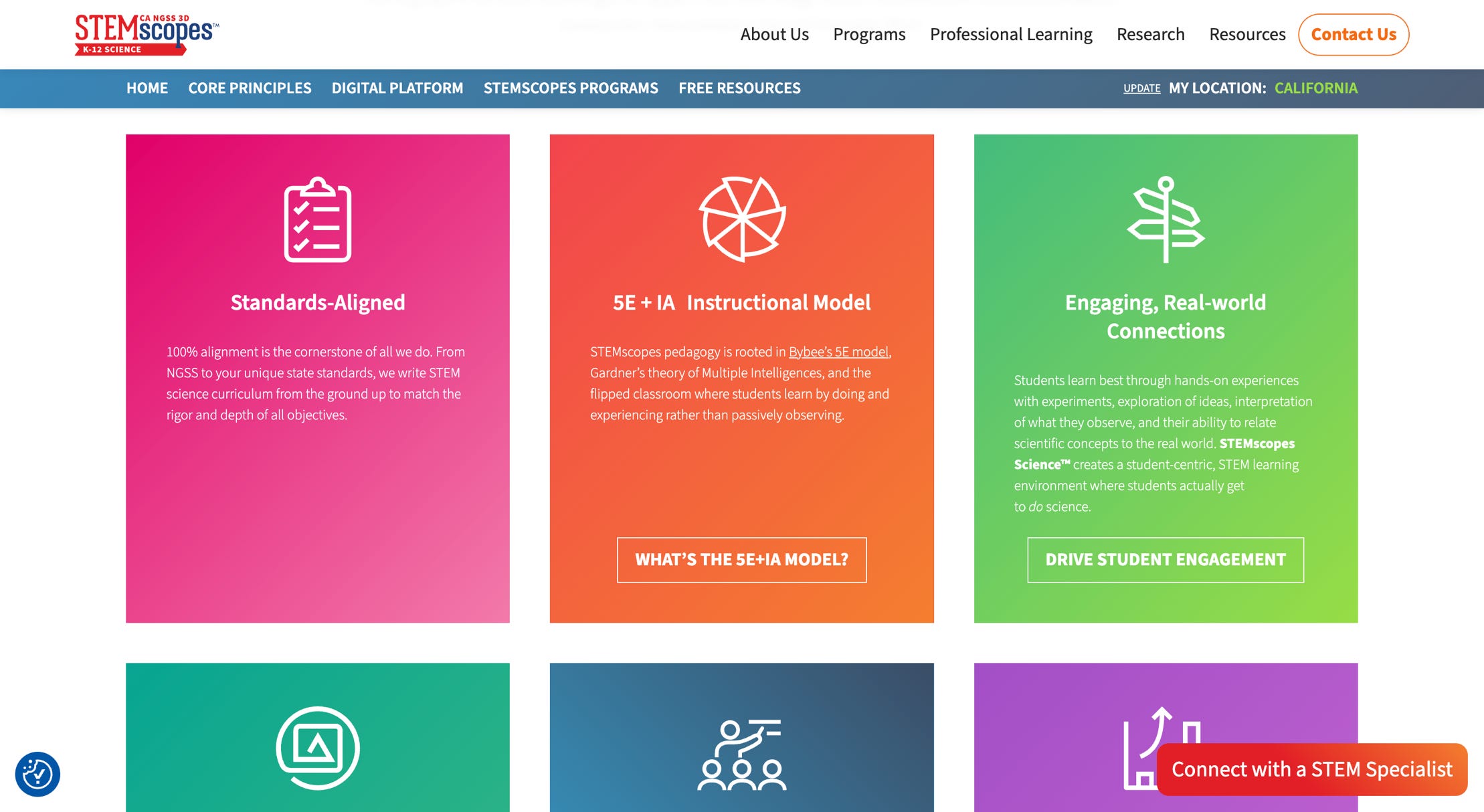
Note that Gardner’s theory of multiple intelligences is disputed as pseudo-science, lacking empirical evidence and relying on subjective judgements.
The two professors hired by LCUSD to review parent concerns about STEMscopes and National Geographics’ Exploring Science were in the Department of Elementary Education, and the Department of Secondary Education. You can see the presentation slides they used when presenting their results to the LCUSD Governing Board at their meeting on May 19, 2020 here. You can view a recording of their presentation at the 22m10s mark here:
Sweller, J. (1994) “Cognitive load theory, learning difficulty, and instructional design.” Learning and Instruction, 4(4), pp. 295–312.
Willingham’s full quote is, “Data from the last thirty years lead to a conclusion that is not scientifically challengeable: thinking well requires knowing facts, and that’s true not simply because you need something to think about. The very processes that teachers care about most — critical thinking processes such as reasoning and problem solving — are intimately intertwined with factual knowledge that is stored in long-term memory (not just found in the environment).” From Willingham, Daniel Why Don't Students Like School? A Cognitive Scientist Answers Questions About How the Mind Works and What It Means for the Classroom (Jossey-Bass, 2009), p.28.
Haring, N. G., & Eaton, M. D. (1978) “Systematic instructional procedures: An instructional hierarchy.” In N. G. Haring, T. C. Lovitt, M. D. Eaton, & C. L. Hansen (Eds.), The fourth R: Research in the classroom (pp. 23–40). Charles E. Merrill.
Rodger Bybee and his Biological Sciences Curriculum Study (BSCS) developed the model in 1987. Learn more about it here.
I have written previously about Fountas & Pinnell’s BAS usage in LCUSD. For a succinct summary of the problems with Calkins’ Units of Study, see Robert Pondiscio’s piece here. For the definitive takedown of the whole language and balanced literacy movements, see Emily Hanford’s 2022 epic podcast series Sold a Story.
Wolpert, Lewis. The Unnatural Nature of Science. Cambridge, MA: Harvard University Press, 1992.
The part about the CSUN Ed school professors saying all of the scientific errors in the original textbook, collectively, was minor is very telling. When you devalue content, whether it’s fully accurate or not becomes much less significant.
Teaching science via a method that science itself rejects, what could possibly go wrong? Facts (and textbooks) matter, and knowing facts is vitally important before doing experiments. After all, you'd never go and do brake work on your car before knowing how the brake system works and what all its component parts are, would you?